The National Police Air Service (NPAS) provides helicopter and fixed-wing air support to all 43 police forces in England and Wales. It is a jointly-owned civilian service, funded by the forces it serves. For members of the public who see a police helicopter overhead, and for officers who have worked alongside NPAS on the ground, understanding what the service does and how it operates gives useful context to one of the more visible tools in UK law enforcement.
What NPAS Does
The primary role of police air support is to assist officers on the ground during active incidents. That covers suspect pursuit and containment, missing person searches, public order monitoring, firearms incidents and major event coverage. The aircraft provide a perspective and capability that ground units cannot replicate — the ability to track a fleeing suspect across an area, monitor crowd movements at scale, or coordinate multiple ground units simultaneously.
Officers who have worked incidents with NPAS support will be familiar with how significantly the aerial view changes the dynamic of a foot pursuit or a vehicle stop. The thermal imaging camera in particular makes night-time searches and evasive suspects considerably harder to lose once the helicopter is overhead.
NPAS aircraft are also deployable across force boundaries, which means a helicopter based in one force area can respond to an incident in a neighbouring force if demand requires it. This national mobility is one of the efficiencies the NPAS model was designed to deliver over the previous model of individual force-owned aircraft.
The NPAS Fleet
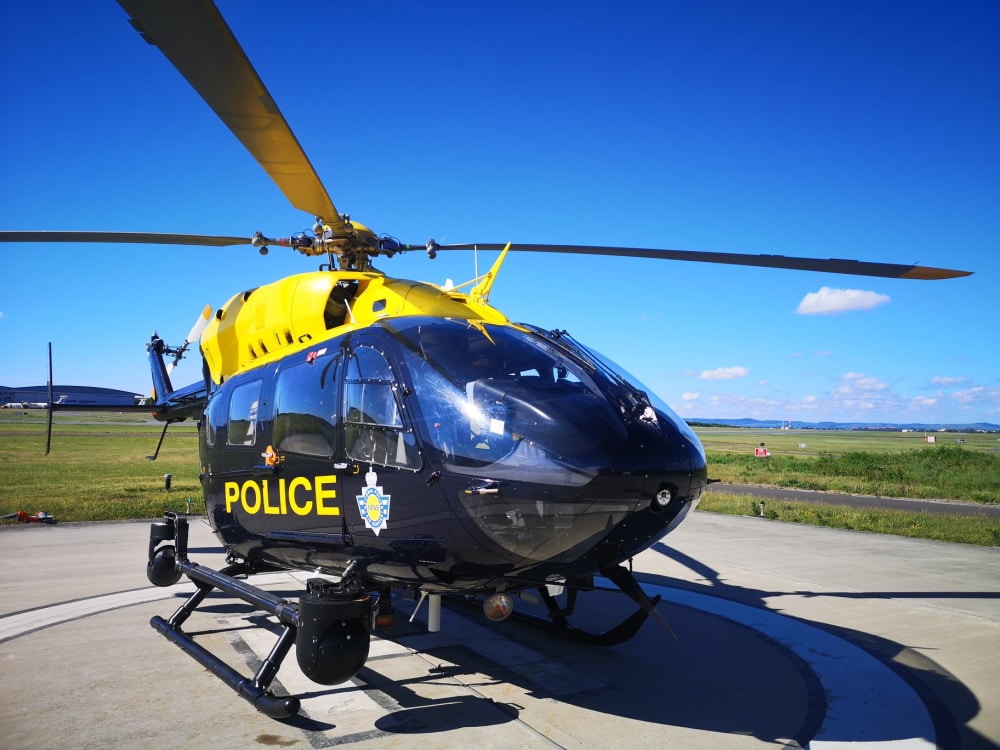
The NPAS fleet consists of Eurocopter EC135 and EC145 helicopters alongside Vulcanair P68R fixed-wing aircraft. The helicopters carry Forward Looking Infrared (FLIR) cameras, night vision equipment and police radio systems as standard fit. The FLIR system is the key tool for night searches, producing thermal imagery that allows crew to track individuals by body heat in conditions where ground officers would have no visibility.
The distinctive dark blue and yellow livery on NPAS aircraft serves a practical purpose — the yellow markings assist other aircraft in identifying the police helicopter from above, while the dark blue aids identification from alongside or below.
NPAS Bases Across England and Wales
NPAS operates from 14 bases across England and Wales, with an additional London base at Lippitts Hill in Epping Forest providing 24-hour coverage for the Metropolitan Police Service area. Police Scotland operates its own separate air support unit based at Clyde Heliport, covering all operational requirements across Scotland independently of NPAS.
NPAS Crew and Roles
Aircraft are crewed by a pilot alongside Tactical Flight Officers (TFOs). TFOs are typically police officers or police staff seconded from force roles rather than aviation professionals — they bring operational policing knowledge to the crew rather than flying expertise. The TFO operates the camera systems, communicates with ground units and coordinates the tactical picture during incidents.
Selection for TFO roles is competitive, involving a rigorous recruitment process across multiple stages. The initial TFO course is a three-week residential programme run by West Yorkshire Police on behalf of NPAS.
Why Is the Police Helicopter Over My House?
A police helicopter operating over a residential area will be responding to an active incident. That might be a suspect pursuit, a misper search, a firearms incident or support to a major public safety situation. Ground officers will be working the same incident below.
Not every helicopter overhead is a police aircraft — air ambulance, coastguard and commercial traffic all use the same airspace. NPAS forces publish operational updates on social media when the helicopter is deployed over populated areas, so checking the relevant force Twitter or X account will usually confirm what is happening.
More About Police Roles and Specialisms
For an overview of how the police service is structured, the UK police ranks guide covers the rank structure from constable to chief constable. Officers interested in other specialist roles will find the police motorbikes guide covers roads policing and traffic units in detail. The police dogs guide covers the role of dog handlers and the breeds used across UK forces.