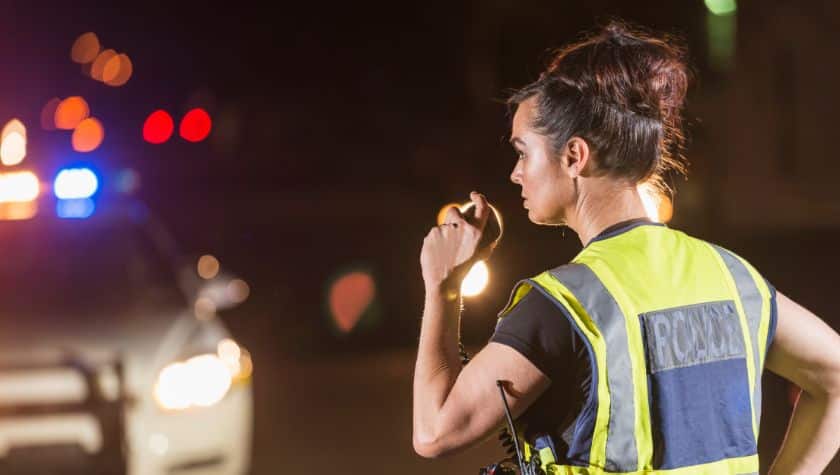
UK police use the NATO phonetic alphabet, the same A to Z used by the military, aviation and the other emergency services. There’s no separate police version. Here’s the full list, with how to say each word.
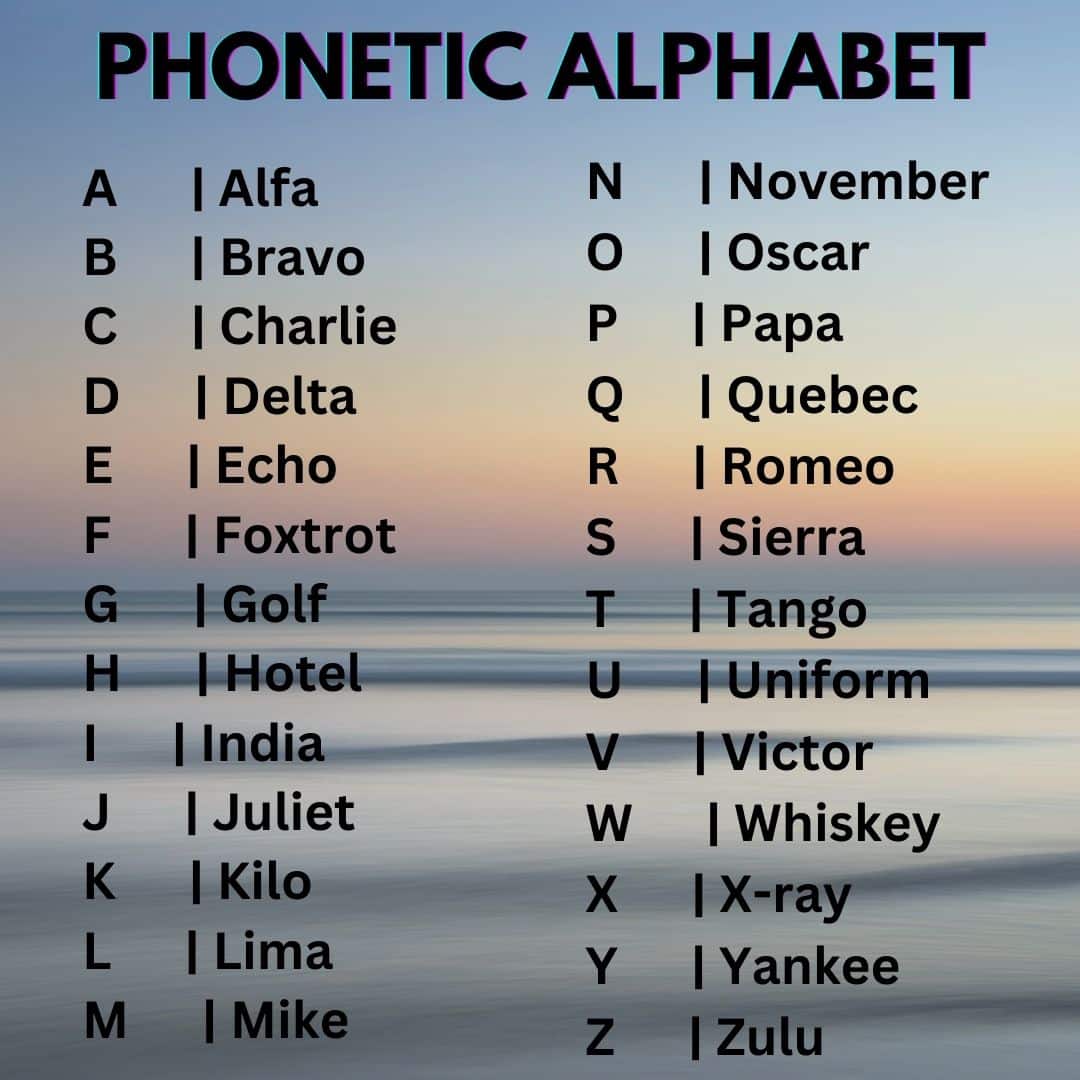
| Letter | Code word | Say it |
|---|---|---|
| A | Alfa | AL-fah |
| B | Bravo | BRAH-voh |
| C | Charlie | CHAR-lee |
| D | Delta | DELL-tah |
| E | Echo | ECK-oh |
| F | Foxtrot | FOKS-trot |
| G | Golf | GOLF |
| H | Hotel | hoh-TELL |
| I | India | IN-dee-ah |
| J | Juliett | JEW-lee-ett |
| K | Kilo | KEY-loh |
| L | Lima | LEE-mah |
| M | Mike | MIKE |
| N | November | no-VEM-ber |
| O | Oscar | OSS-cah |
| P | Papa | pah-PAH |
| Q | Quebec | keh-BECK |
| R | Romeo | ROW-me-oh |
| S | Sierra | see-AIR-rah |
| T | Tango | TANG-go |
| U | Uniform | YOU-nee-form |
| V | Victor | VIK-tah |
| W | Whiskey | WISS-key |
| X | X-ray | ECKS-ray |
| Y | Yankee | YANG-key |
| Z | Zulu | ZOO-loo |
What is the police alphabet?
It’s a set of agreed words that stand for letters, so a name, registration or postcode survives a bad signal, a noisy street or a strong accent. On a poor radio, B, D, P and T can all sound alike. Bravo, Delta, Papa and Tango don’t.
“Police alphabet” and “UK phonetic alphabet” are just everyday names for the same thing. Its proper name is the International Radiotelephony Spelling Alphabet, and strictly speaking it’s a spelling alphabet rather than a phonetic one, because it spells words out and doesn’t describe sounds.
How the alphabet is used on the radio
The usual jobs are the details that can’t be guessed from context: surnames, vehicle registrations, postcodes and reference numbers. Anyone who’s spelled a surname over a poor signal knows why it matters, because one wrong letter can send a check back on the wrong person or vehicle.
In practice it sounds like this:
- The surname Smyth becomes Sierra Mike Yankee Tango Hotel.
- The registration AB12 CDE becomes Alfa Bravo One Two Charlie Delta Echo.
- The start of the postcode SW1A becomes Sierra Whiskey One Alfa.
Call signs and local shorthand are a separate matter and vary between forces, so learn those from your own force’s guidance.
How to say the numbers
The international standard also sets out how to say each digit. Some of them are said differently from everyday speech, such as “niner” for nine, to make them harder to mishear.
| Number | Say it |
|---|---|
| 0 | ZE-RO |
| 1 | WUN |
| 2 | TOO |
| 3 | TREE |
| 4 | FOW-er |
| 5 | FIFE |
| 6 | SIX |
| 7 | SEV-en |
| 8 | AIT |
| 9 | NIN-er |
“Tree”, “fife” and “niner” come from the aviation and military standard. You won’t necessarily hear them on every police radio, so follow what your force teaches.
Mistakes to avoid
The biggest one is making up your own words under pressure. “B for Bob” feels helpful, but the person listening is expecting Bravo and has to stop and think. Older words such as “S for Sugar” still turn up on the phone, but they’re best left off the radio.
The second is rushing. The code words only work if each one is clear, so a steady pace beats a fast one. Group a registration the way it’s written, and if a letter’s been missed, spell it again instead of repeating the whole thing louder.
Spelling trips people up too, though it makes no difference to how the words sound. The official forms are Alfa and Juliett, while you’ll often see Alpha and Juliet written down.
Where the alphabet came from
The current version was developed by the International Civil Aviation Organization and came into use on 1 March 1956. NATO adopted it at about the same time, which is where the popular name comes from, and the International Telecommunication Union followed by 1959.
It replaced earlier lists that used words such as Able, Baker and Zebra. The odd spellings are deliberate: Alfa has an F because not every language reads “ph” as an F sound, and Juliett has two Ts so French speakers don’t treat the final T as silent.
Frequently Asked Questions
What alphabet do UK police use?
UK police use the NATO phonetic alphabet, from Alfa to Zulu. It’s the same one used by the armed forces, aviation and the other emergency services.
Is the UK phonetic alphabet different from the NATO one?
No. The standard UK phonetic alphabet is the NATO alphabet. Some businesses and call centres use their own variations on the phone, but those aren’t the official version.
Do PCSOs, specials and police staff need to know it?
Anyone who passes details over a radio or phone will find it useful, and that includes PCSOs, special constables and control room staff. It’s quick to learn with a bit of regular practice, such as spelling out number plates you see while you’re out.
What does Tango Lima Charlie mean?
It simply spells out the letters TLC. The alphabet has no hidden meanings of its own, so any phrase like this is only standing in for the letters.
What does Oscar Kilo mean?
Oscar Kilo spells OK. It’s also the brand name of the National Police Wellbeing Service, so you may see it on posters or wellbeing vans in your force.
Is it Alfa or Alpha?
The official spelling is Alfa, although both are said the same way and you’ll see Alpha written down all the time. On the radio, nobody can hear the difference.
Learn it once and it’ll serve you for the whole of your service, and well beyond it.
More From Police Discount Offers
If you’re learning the language of the job, our guides to UK police ranks and how to become a police officer are good next reads. For something lighter, there’s a phonetic alphabet mug among our police gifts.
Police Discount Offers lists deals for officers, staff, PCSOs, specials and retired officers, with some open to families too, so have a look through the latest police offers while you’re here.